For most high-growth SaaS and engineering teams, the words "SOC 2 Type II audit" trigger immediate anxiety. It usually means weeks of frozen deployments, chasing down engineers for screenshot proof of code reviews, and digging through quarterly spreadsheets to prove access logs were reviewed.
At ThunderCoders®, we treat compliance differently. A SOC 2 Type II report shouldn't be a side project or a once-a-year freeze—it should be a natural byproduct of how your software already runs.
Here is how modern engineering squads build compliance controls directly into their codebase and shipping pipeline.
The Problem with "Audit by Spreadsheet"
Traditionally, organizations treat security compliance as an administrative layer slapped on top of engineering. When audit season arrives:
- Engineering velocity drops as developers stop feature work to gather static evidence.
- PRs are subjected to manual checks that slow down deployment cycles.
- Auditors receive disconnected screenshots that reflect a single point in time rather than continuous operational health.
This approach creates friction between product goals and security requirements. When security is out of band with engineering, velocity suffers—or worse, controls are skipped under pressure.
Shifting Compliance Left: Evidence Capture in CI/CD
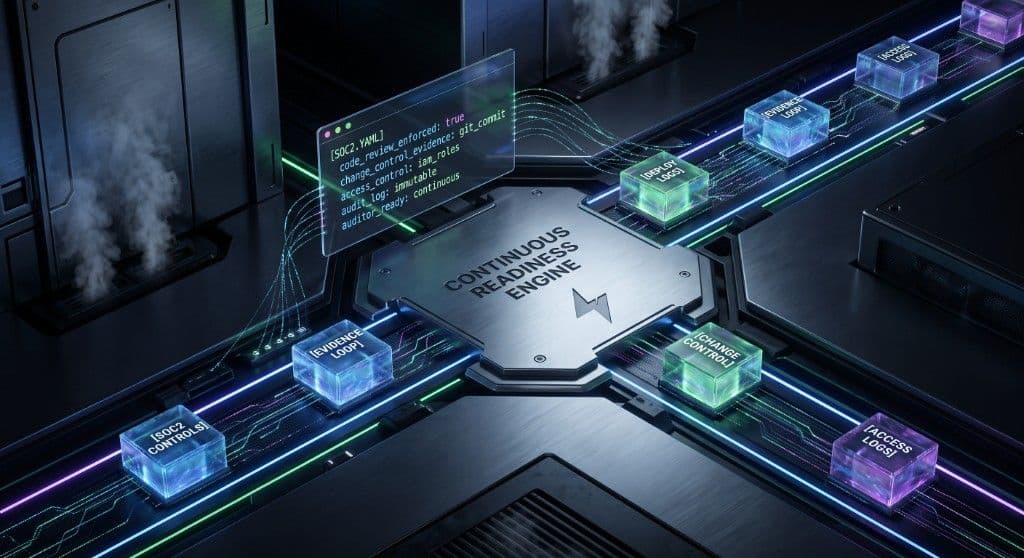
Instead of halting deployments to prove compliance, senior teams design evidence collection into the CI/CD pipeline itself. When controls ride along with pull requests and automated checks, evidence accumulates continuously as a side effect of shipping code.
1. Change Management in the Repository
Every change to production software should have a clear, traceable paper trail. By enforcing pull request rules—requiring automated test passing, peer approvals, and branch protection directly in your VCS—your Git history becomes your change management log.
2. Infrastructure as Code (IaC) & Identity Controls
Access control shouldn't rely on manual provisioning checklists. By defining access policies, IAM roles, and cloud environments via Infrastructure as Code (e.g., Terraform, Pulumi), every modification is reviewed, version-controlled, and audited automatically before hitting production.
3. Automated Evidence Logging
Rather than logging into consoles to pull audit trails manually, set up automated pipelines that aggregate identity events, dependency scans, and deployment logs into secure, immutable storage. When the auditor asks for proof, the report is already generated.
The Result: Continuous Readiness
When readiness is built into your backlog and repo from day one:
- Zero-Freeze Audits: You don't have to pause development to collect proof; evidence is recorded in real time.
- Faster Sales Cycles: When enterprise buyers ask for SOC 2 or HIPAA assurance, you can demonstrate operational controls instantly.
- Healthier Codebases: Security best practices stop being a hindrance and become standard operating procedure.
The Takeaway
You shouldn't need a separate build team and compliance team. The same engineers designing your cloud architecture and AI pipelines should be designing the evidence loops your assessors will inspect.
Preparing for SOC 2 Type II or building enterprise-ready software under tight timelines? Let's talk.